

Bill Callahan on ‘My Days of 58,’ Smog, Noah Cyrus, Fatherhood
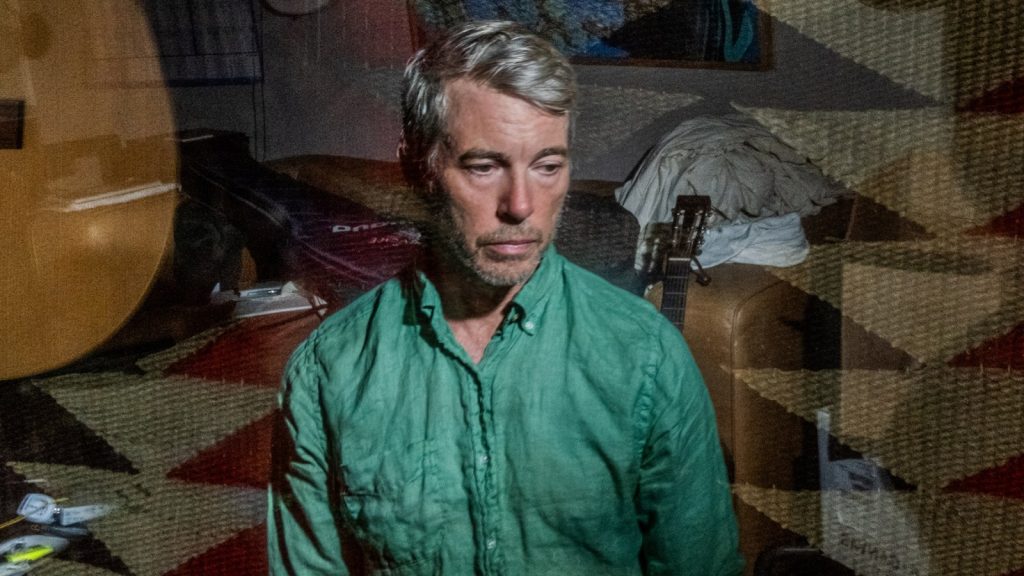
Bill Callahan thinks it’s “almost taboo” for musicians “in the independent rock world,” as he puts it, to publicize their age. Nevertheless, he titled his new album My Days of 58.
“One day out of the blue,” Callahan explains, “my son asked me, ‘Are you working on a new album? What’s the title?’ And I said, ‘Do you have any ideas?’ He said, ‘How old are you?’ I told him. He thought about it for a second, and he said, ‘How about My Days of 58,’ which is a very poetically phrased thing.
“It was a strange thing to come out of a 10-year-old boy that hates to read and likes gaming and The Simpsons,” he says. “I don’t know where he got that, but it fit perfectly.”
Callahan is speaking with Roling Stone over Zoom from his Austin home studio. Even if he didn’t publicize his age, it would be apparent: Now actually 59, his hair has more salt than pepper in it, but he also looks content with what seniority in the world of independent rock has given him. He’s surrounded by paintings, like the one on the cover of his 2011 album Apocalypse, and guitars hanging from his wall.
The new album, one of dozens Callahan has released since emerging from the late-Eighties lo-fi cassette community, contains self-analytical songs about maturing as he’s aged (“Pathol O.G.”), fatherhood from both his recently deceased dad’s and his own perspective (“Empathy”), and living up to his wife’s expectations of him (“The Man I’m Supposed to Be”). Where the music he recorded decades ago using the name Smog was sparse yet exacting, the folky arrangements of My Days of 58 sound loose and live, thanks to Jim White’s drumming and lively horn and string arrangements that enhance Callahan’s confessional and often hilarious lyrics. “We take life seriously, laugh in the face of death,” he sings on “The Man I’m Supposed to Be,” which he punctuates at the end with a falsetto “hee-hee.”
Years ago, the openness of My Days of 58 might have seemed unimaginable for Callahan. Smog’s early albums sounded brittle and brooding, until he found his voice in the late Nineties and started recording ultra-ironic meditations on death and desire, sometimes at the same time (see: “Dress Sexy at my Funeral”). At the time, he was unapproachable, literally, conducting interviews by fax, though he now downplays the number of facsimiles he actually sent. In 2007, he started releasing albums under his own name, and in 2014, he got married and had a kid. Beginning with the release of Shepherd in a Sheepskin Vest in 2019, Callahan started feeling comfortable showing his true self in song.
Once elliptical in interviews, he’s also more open talking about himself now. During an hour-long talk with Rolling Stone, he looks back on how fatherhood changed him as an artist and on a fundamental level. He’s eked out a living, he says, that supports himself and his family, which has helped him find peace with getting older.
Blues musicians are celebrated as they age. Why don’t you think it’s the same for you?
It’s because “indie” ends in an “I-E.” It sounds like something that young people should do.
I’m surprised you consider your genre “indie.”
It seems to be the truest name for it. There’s folk and country, but I don’t really feel like I’m either of those. “Indie” just means I’m independent, and I can do whatever I want. I used to hate the word indie and thought it was kind of demeaning because it ended in “I-E” and it made it sound like a junior thing, like mini. But I’ve actually really embraced that idea. Each record can sound different from each other, and no one can say, “Wait, this isn’t an independent record,” like they can say, “This isn’t the blues.”
I’m not a very sentimental person, but when I reflect on the early days of independent music, something happened there. People were taking things into their own hands and setting up their own shows. I was carrying boxes of my records into record stores on tour and trying to sell three or four copies. In retrospect, it was kind of a special time that is gone now.
Did you think you’d still be releasing records as you approached 60?
I did. Once I made the decision to go for it and not go for what I was supposed to — like a college degree and a career that had a clear-cut advancement in it — I knew that I was going to be doing it forever, no matter what happened. If people stopped caring at some point, I would keep doing it.
When did you experience that epiphany?
It was before making Sewn to the Sky, my first album [released in 1990]. That’s when I bought a four-track and pressed up my first album with my own money.
How do your early albums like Sewn to the Sky and Julius Caesar sound to you now?
I mean, they sound like shit.
Wasn’t that the point?
I guess it was, yeah. I proved my point very well. I haven’t listened to Julius Caesar in a long time, but I feel like that was an important breakthrough record in my personal musical development. I think things got a little more palatable, but it was still kind of rough. It was kind of exciting, fast-paced, kind of kaleidoscopic, different-sounding record.
When did you hit your stride?
Red Apple Falls [released in 1997] is when I felt I was getting my own voice, because I got into a real studio and I could actually hear what I sounded like. That gave me more ability to steer where things were going and be subtler. It’s hard to be subtle on a four-track.
Your lyrics used to be fictional character studies. How much of the new album is autobiographical?
Recently, everything is autobiographical. When I started Smog, I was trying to get into other people’s heads by taking the first-person perspective. That’s why a lot of it was about cruelty and trying to understand how people like that think, like on [Red Apple Falls’] “Ex-Con.”
This one is about 90 percent me. It’s really very much from the heart. I didn’t take my chili spoon on my honeymoon [a lyric on “Highway Born”], but that’s the only untrue thing.
Right after you say that, though, you literally say, “That’s true.”
My wife and I do love chili, so it’s close to being true.
When did you pivot your writing perspective to autobiography?
It must’ve been Shepherd in a Sheepskin Vest, just because I didn’t make a record for five years, which was a long time for me. That was just because my firstborn was here, and I was trying to figure out what it means to be a father and how it fits into the rest of this life I had that was very focused on music. That was a big shock.
I was kind of like, “Is it OK to write about being married and having kids? Does anybody care about that?” I just realized that was the only way I was going to make an album. So I took a purely autobiographical stance. That’s why there’s, like, 20 songs on that record. I just had to get everything out that I could.
What did you do during the five years you weren’t making records?
We lived in Santa Barbara for a year because my wife went back to school. It was really hard for me to see this baby in need and to do anything but help him. That was my priority. It was very hard to leave my wife to look after the baby by herself [for me to write music], so I was doing a lot of being a dad, and that’s a full-time job.
Was being an independent musician enough to support a family those five years?
Yeah. Before I got married, I saved up a lot of money. So I had eff-you money… Plus, thankfully, I’ve got a lot of records, and people keep buying them, which is great. So my old records are constantly selling at a nice little trickle.
How did you break through the writer’s block?
I eventually started seeing a therapist to help me get back in the groove. But what really happened was we left Santa Barbara and came back to Austin. We returned to the same house we were in before, and that is when the flood gates opened. I realized I needed the familiarity, the comfort. In Austin, I know where everything is, I know how to get everywhere, but in Santa Barbara, I was displaced, and it wasn’t good for my state of creativity.
What have you been listening to lately for inspiration?
My friend gave me Garland Jeffreys‘ first album. It was a golden kind of sunshine record. It was a big inspiration for My Days of 58, because I liked the acoustic sound of it. And I’m always listening to Merle Haggard. I could listen to him forever, and it always sounds so good.
You also shouted out Lou Reed on “Why Do Men Sing.”
I had a dream about him after he died, which is in the song. I think it’s really important to celebrate the people that came before you. I use a lot of [Lou Reed’s] chord progressions. I mean, the ones that everybody uses. They’re kind of like sacred geometry. It always means something.
I’ve got a postcard I’m looking at right now that Lou wrote to a friend of his that became a friend of mine later. They would send each other CDs in the early 2000s. And she’d sent him a Smog thing, and he’s raving about it on this postcard that he sent to her. It doesn’t say which album, but it was probably Rain on Lens [released in 2001]. I got it framed on my wall right there.
Between your Lou Reed dream and your new song, “And Dream Land,” I was wondering if you still keep a dream journal.
Yeah, when I remember them. I felt like there was something missing from the album, so I wrote “And Dream Land” two days before we started recording. The stuff about being in the desert on my back and rising up to the mothership with a glowing pyramid in my abdomen, that was a very beautiful dream I had.
I was diagnosed with cancer in December or January a year ago, and I had that dream. It was colon cancer, so I saw the glowing pyramid in my abdomen as a sign that I’m going to be OK, because pyramids traditionally have healing powers.
How is your health now?
I’m good. I had an operation. It was Stage I, thank God, and I didn’t have to do any chemo or anything like that. And then I just had my year-later colonoscopy, and that was fine.
You recently recorded a duet with Noah Cyrus, “XXX.” How did that come about?
I was friends with Richard Russell, who worked at XL Records when he produced a Gil Scott-Heron record, and they covered one of my songs. One day [Richard] wrote me and said, “I’m going to be in L.A. doing some recording. Is there anybody you would like to write a song for?” And I said Noah Cyrus because I was a big fan.
How did you become a Noah Cyrus fan?
I saw the title “Mr. Percocet,” her single from her previous album, and it was really just that title. I was like, “Wow, that’s a great title for a song.” And then I heard it and I was like, “Oh, this is a great song,” so I listened to the album that that was on and really liked that.
Then what happened?
The next day, he was like, “She’s in.” So I had to write a song in, I don’t know, two or three days. Noah and I just started chatting a little bit, and she wanted to do some co-writing, so I went to L.A., and we did some recording. She’s a very easy person to like and to work with. There was no weird nervousness. We have other songs that we’re working on together that someday is going to be an EP. But she liked “XXX” so much, she was like, “I want to put this on my record.”
How was it recording with her?
She’s got a really powerful singing voice, and then getting to witness it in the studio is just amazing. She can belt it out, or she can be fragile and wistful. I could just tell from the record that she was “a real one,” as they say.
One of the funniest songs on My Days of 58 is “Pathol O.G.” You sing, “It’s important to not treat your lifeboat like a yacht.” What does that line mean to you?
Making music really was my lifeboat. But then as my career progressed I started to realize sometimes I was going through the motions or going to my studio and playing guitar as an avoidant thing when there was so much other stuff that I was responsible for that I should have been taking care of. But you have this golden pass if you’re like, “Well, I’m an artist. I can’t take the car in for an oil change.” So that was what I was thinking about.
But obviously having kids made that pure artist’s life not attainable anymore anyway, and taught me that there’s a finite amount of creativity that gets loaded into you, so I don’t really need to be sitting here 12 hours a day. I can do it in five.
And it was also just realizing a well-rounded life gives you so much back. So if I’m just sitting here all the time, then I’m boring as hell. I don’t have anything to talk about or think about. But if I’ve taken care of the house and socializing and exercising and all the things that I would tend to neglect back in the day, those things only add to my well-roundedness as a human.
It sounds like you’ve settled well into domestic life.
I’ve embraced it, I’ll put it that way. This is a job, and people do love to punch out at 5:00 or whatever on any job. I like going and switching gears and making dinner for my family now, whereas I used to resent it. I’ve had two different types of life already.
BTS Star on Solo Hits, ‘They Don’t Know ‘Bout Us.”
A sk all of BTS which member can hit the highest notes, and they’ll point to...
‘Arirang,’ Finding Hope, Writing About Romance
J -Hope is “softly spoken and kind of elegant,” says one of his Arirang collaborators,...
BTS Rapper on Making ‘Arirang,’ Hip-Hop, What’s Next
T he story goes that Suga, born Min Yoongi, got his nickname from the phrase “shooting...
Rock Influence, Solo Work, Coldplay, Touring With BTS
A mong the things that Jin, born Kim Seokjin, loves the most in this world are...