I loathe making lists like this, even when I love the things I’m listing. It’s like asking what’s the favorite breath you’ve ever taken. I have long thought that this as a can’t-win situation, one that risks the wrath of the “Org’ers” (the members of Prince.Org — a group he and I feared). But here I am, trying to win.
There’s a rumor that I only value the first 10 years of Prince’s career — perhaps because I have said things like that over the years. I plead guilty, to some degree, though I have my reasons. Over that first decade, Prince consistently delivered revolutionary music in every way: the lyrics, the arrangements, the playing, the vocals. And I was ripe for receiving it all, 11 to 21, open to new ideas and constantly feeling an exhilarating connection to what he was making. As I grew older, my expectations shifted. I became less responsive to new releases, less capable of being hit with sledgehammer force each time. Still, after his passing, I began to hear his music differently, leading me to revisit his entire catalog. It has taken me ten years to approach his later work with the right mindset, and I am still working on it.
A few ground rules:
In making this list, I am considering anything Prince wrote and/or produced that received a public release. By this point, that includes several outtakes and demos that have found their way onto deluxe reissues. The vast majority of these songs are available for streaming. A handful aren’t, for reasons of contractual red tape. (You can go to YouTube.)
The Top Ten has been in print, but even those entries appear here in slightly different, sometimes longer versions. As you’ll see, I like the extended remix.
There are a hundred entries, but does that mean there are a hundred songs? I bent the guardrails here and there when a duo or trio of songs seemed of a piece or worth considering as a package deal. I didn’t do it often. But it was a way in getting in a little more Prince. Sometimes a hundred just isn’t enough.
Finally (and this is an important caveat) I am not compiling a list of Prince’s biggest songs or even his quote-unquote best. Some of your favorites may be missing. This is because I look not to the songs with the largest pop-culture footprint but to those that tell me the most about him and how he made music. Some monster songs are of course included, but to me, what he did between them is what matters most. My goal in making this list is to provide a cheat code into why Prince was, is, and will always be genius.
Okay. The list.
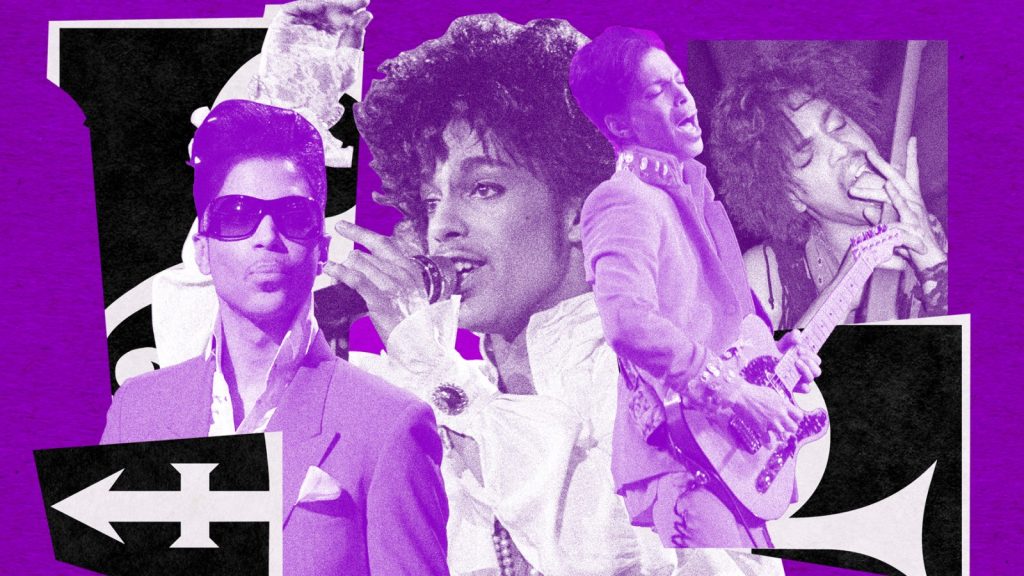
Photographs in Illustration By
Kevin Winter/Getty Images; Larry Busacca/WireImage; Jed Jacobsohn/Getty Images; Michael Ochs Archives/Getty Images
‘Alphabet St’
Image Credit: youtube
From:Lovesexy (1988) Recorded: December 1987
When Prince fans learned that the highly anticipated Black Album, the followup to Sign O’ The Times, was being shelved for something “more spiritual,” they — we — were left bewildered. The only spiritual element I could discern in this, the first single from the replacement album Lovesexy, was Prince playfully mocking the recently disgraced televangelist Jimmy Swaggart in the bridge (“if you don’t mind, I’d like to… watch”). Despite my confusion, I was pleasantly surprised by his (yet again) inventive mastery of the Linn drum machine.
‘In A Large Room With No Light’
Image Credit: Goedefroit Music/Getty Images
From: Sign O’ the Times Super Deluxe Edition (2020) Recorded: May 4, 1986
This track feels like a sonic soup of everything Prince was inhaling from Wendy & Lisa, Eric and Alan Leeds, and whoever else had his ear in those glory days. While mere mortals would just copy their influences, Prince was the kind of cat who would take a tiny speck of an idea, flip it, stretch it, and reverse it until it was 100 percent Purple. This song represents his first real baby steps toward creating a completely fluid, genreless universe. It isn’t funk, rock, jazz, or fusion. It isn’t pop or Latin. It’s just Prince. And the wild part? He was just getting started. Buckle up, kids!
‘Visions/Dream Factory’
Image Credit: Bill Marino/Sygma via Getty Images
From: Sign O’ the Times Super Deluxe Edition (2020) Recorded: March 10, 1986 /November 1986
A significant part of Prince’s Revolution-era highlight reel stems from his close relationship with collaborators Wendy Melvoin and Lisa Coleman, whose contributions often go unsung. This piano instrumental underscores his collaborative spirit. During the pandemic of 2020, this song became my morning wake-up call, providing….well…a reason.
‘Uptown’
Image Credit: Vinnie Zuffante/Getty Images
From: Dirty Mind (1980) Recorded: May-June 1980
An ode to the Poets, Part Time Singers, Puerto Freakans, Pimps & Thangs on the funky side of town.
‘She Spoke To Me’
Image Credit: Tracy Tremblay/WireImage
From: The Vault..Old Friends for Sale (1999) Recorded: October 1991
My main issue with post-1988 Prince was the upgrade in sound. I believe artists thrive within limitations. They spark inventiveness. Even in Prince’s bedroom recordings, the lo-fi quality added a unique charm to the songs. As he had access to more and more elaborate studio setups, his work sounded more and more (so-called) professional, and I wasn’t pleased with the sonic results, even if I respected his craftsmanship. That said, this particular song gets a pass (a Purple Pass) for its sophisticated sonics, which fit its smooth-jazz vibe perfectly.
Madhouse, ‘Thirteen’
Image Credit: Rob Verhorst/Redferns/Getty Images
From: 16 (1987) Recorded: August 1987
This is one of the most sinister gangsta ass riffs in Prince’s arsenal. His ability to make his table scraps into magical feasts is mind blowing. So badass.
‘Purple Music’
Image Credit: Jim Steinfeldt/Michael Ochs Archives/GettyImages
From: 1999 (Super) Deluxe Edition (2019) Recorded: May 22, 1982
This is pretty much Prince’s “I’m already crazy enough, so why would I wanna go over the edge and mess it up doin’ dope and stuff, huh?” song. You can feel him trying to navigate his way around and test out his new toys (the Linn LM-1 & Oberheim Synth).
‘Our Destiny/Roadhouse Garden’
Image Credit: Richard E. Aaron/Redferns/Getty Images
From:Purple Rain Deluxe Edition (2017) Recorded: June 7, 1984
This song was originally earmarked for what would have been the follow-up to 1985’s trippy Around the World in a Day. The second half of this track was initially set to be the title song but was shelved for a fresh idea: a black-and-white comedy called Under the Cherry Moon. Prince was the king of seeing a project all the way through the final fade only to shrug it off and act it like it was never there to begin with. When I asked about the status of this project decades later, it took him a sec to even remember its existence. Must be nice.
‘Annie Christian’
Image Credit: Gary Gershoff/Getty Images
From:Controversy (1981) Recorded: August 14, 1981
This marks the first appearance of two drum machines: the Linn LM-1, which would become a staple in Prince’s arsenal for decades, and the Korg Mini Pops SR-120, used just this once. Sonically, this track stands out from the rest. The sloppy natural hand claps were chef’s kiss to me back then — it felt like they were recorded in my high school bathroom! I’ve lost count of the times I’ve asked engineers to stretch miles of mic cords from the soundboard to a bathroom in any studio just to capture that texture.
‘Why You Wanna Treat Me So Bad?’
Image Credit: Brian Rasic/Getty Images
From: Prince (1979) Recorded: May 9, 1979
This exemplifies my contrarian rebellion against Prince singles. I grew up in an era when radio DJs had the freedom to play whatever they wanted. Singles ruled the airwaves, but you could easily rock a filler cut if you chose. While everyone was losing it over the overplayed “I Wanna Be Your Lover,” I was hooked on “Why You Wanna Treat Me So Bad?” largely for the infectious bass and Clavinet riff. This track deserved way more recognition.
‘Anotherloverholenyohead (Extended Version)’
Image Credit: youtube
From: “Anotherloverholenyohead” single (1986) Recorded: Dec 16, 1985
A song that showcases one of Prince’s most underrated talents: bass player. His bass work often assumes the alpha role, as seen in tracks like “777-9311.” Sometimes, we notice its absence, as in “When Doves Cry” and “Kiss.” And then there are the moments when he completely transforms a song with bold bass lines, like the 12-inch versions of “Little Red Corvette” and “Raspberry Beret.” And here. At the 4:30 mark, he plays the bass with such intensity that it feels like a personal attack. It’s such an all-consuming performance that it makes you forget everything that came before it.
The Time, ‘Get It Up’
Image Credit: Gary Gershoff/Getty Images
From: The Time (1981) Recorded: Feb 11, 1981
While Prince’s struggle to become a mainstream rock star is well-documented, I challenge the commonplace that he had to win over the white audience. There’s always been an exotic allure that attracted white audiences to Black artists. Prince faced a greater challenge in selling his post-Dirty Mind identity: connecting with Black audiences, who often represent a stubborn brand of Christian conservatism. Enter The Time — his proxy to bridge that gap. Once they gave us a hit, we were hooked — Prince was finally invited to his own BBQ!
Sheila E, ‘Noon Rendezvous’
Image Credit: Paul Natkin/WireImage
From:The Glamorous Life (1984) Recorded: Feb 13, 1984
Like Sheila E., this song is gorgeous. Prince rarely dropped the ball on his ballads. However, my true obsession with this song is trying to find “the one” count at the beginning. Long before the “Whitney Houston Challenge” took over social media, I still can’t successfully locate the intro more than forty years later!
‘The Ladder’
Image Credit: Michael Ochs Archives/Getty Images
From:Around the World in a Day (1985) Recorded: Oct 31, 1984
I have mixed feelings about this song. While it’s cool that 2Pac showed love to “the laaaaaaddaaah” back in ’93, it’s heartbreaking to think that during soundcheck in his hometown on Halloween, in the middle of his massive, sold-out-across-the-nation Purple Rain tour, Prince recorded this emotionally naked ballad. The lyrics (“there lived a king who didn’t deserve to be”) capture the profound infinite sadness of a man who had worked so hard yet still felt unworthy of his success.
‘Computer Blue’
Image Credit: Ross Marino/Getty Images
From:Purple Rain (1984) Recorded: August 3, 1983
In just four minutes he manages to 1) get Wendy & Lisa to create the sexiest conversation about something that might be non-sexual (taking a shower? cooking pasta? bathing the dog?); 2) establish a riff you’ll never forget, paired with an unforgettable groove; 3) challenge the then-dominant rawk axework of players like the Eagles’ Don Felder and Joe Walsh (two of them, but only one of him!) only to land the plane with one of his father’s lush compositions; 4) and then, with 45 seconds left on the clock just crash out, song over. The original version was 12 minutes long, and while I doubt Prince ever planned to release it, he definitely wanted to get it out of his system.
‘Cloreen Bacon Skin’
Image Credit: Rick Maiman/Sygma/Getty Images
From: Crystal Ball (1990) Recorded: March 23, 1983
The essence of many of The Time’s songs was Prince and Morris just messin’ round. Prince would grab a fresh reel of tape and record new music over the groove Morris laid down. This time, though, he decided to leave it as a fun party jam for their amusement. It’s about as close as you’ll get to hearing what “in-his-prime” Prince was like behind the scenes, behind closed doors, and behind that purple velvet rope.
The Family, ‘Desire’
Image Credit: Ross Marino/Getty Images
From: The Family (1985) Recorded: June 27, 1984
The Family (the album) features eight perfect jams from The Family (the group), which was formed after The Time shattered post-Purple Rain. Prince joked about wanting that Duran Duran money, and they had everything they needed to get it: the look, the funk, the purple bat signal, and most importantly, the songs. Not a loser in the bunch (we know Sinead was a fan, at least). This is when I start to get angry about how Prince didn’t tend to his legacy better. These songs, including this closer, were gold.
‘Cream (Take 2)’
Image Credit: Staff/Mirrorpix/Getty Images
From: Diamonds and Pearls Super Deluxe (2023) Recorded: December 3, 1990
This alternate take revealed to me why I was slow to embrace Prince’s Diamonds & Pearls era. It captures the nuances I love in his work: a crunch in the mic and compression that pushes the mix to distorted levels. We call it “imperfection,” but it’s really humanity. Delving into the box set that accompanied this LP, I found at least 10 other fantastic “crunch” songs. They would have fit perfectly, especially since just two weeks after the original album’s release, a new revolution called grunge emerged from Seattle.
‘All My Dreams’
Image Credit: Michael Ochs Archives/Getty Images
From:Sign O’ the Times Super Deluxe Edition (2020) Recorded: April 28, 1985
I believe this song (part Roadhouse Garden, part Dream Factory showcase) is what Prince’s brain sounds like inside — twist and turns and most importantly Cap’n Crunch.
‘Crazy You’
Image Credit: Vinnie Zuffante/Getty Images
From:For You (1978) Recorded: November 1977
If I were a betting man, I would say that Joni Mitchell’s Hejira was Prince’s early oxygen, and this is evidence. The song still stands tall (perhaps even taller) to this day.
‘Tamborine’
Image Credit: Gene Shaw/Getty Images
From:Around the World in a Day (1985) Recorded: September 27, 1984
Prince in action was truly unique. None of his peers would risk anything like this. G’head and rock some other 1985 releases at random, then play this. There’s clearly no click track — Prince the tambourine player rushes while Prince the drummer goes wild. He knows it’s a risk, but his perfectly imperfect background vocals are structured with a…shrug-ness…that lets him succeed at a daredevil jump the average musician wouldn’t dare attempt. And this is just a filler track to close out side one. Now that’s dedication.
’17 Days’
Image Credit: Ross Marino/Getty Images
From: “When Doves Cry” single (1984) Recorded: August 1983
While everyone else was obsessed with the A-side of this single, “When Doves Cry,” I was scouring the B-side for clues on whether my 1999 sugar high would sustain or crash. The clunky percussion threw me off some, and I also remember thinking that Prince might like playing the victim. Even in his post-1999 glory, he presents himself as the neglected one, always crying and begging. This marks at least his fourth song where the phone is the weapon of choice for inflicting romantic misery.
The Time, ‘The Walk’
Image Credit: Jeffrey Mayer/Getty Images
From: What Time Is It? (1982) Recorded: January 14, 1982
A treasure trove to unpack: nearly ten minutes of verses, choruses, comedy interludes, wardrobe changes, random appearances of women’s underwear for that ass tho, some stray bullets aimed at disloyal band members, cock-blockin’ player haters, and some chicken grease on the side. Most importantly, it includes instructions for learning a new dance. There’s a list of dislikes (“We don’t like policemen/We don’t like the New Wave/We don’t like television”) that plants the seed that N.W.A will later harvest for hip-hop anthems. “The Walk” truly represents the standard of funk that everyone else was abandoning.
‘Shhh’
Image Credit: Richard Nelmes/Mirrorpix/Getty Images
From:The Gold Experience (1995) Recorded: April 1991
Prince gave Tevin Campbell this song in 1992 for his second album, I’m Ready, only to turn back to it himself two years later. I get PTSD every time I hear that intro. Why? Well, one night at a jam session, Prince called for this song, clearly enjoying the look of terror in my eyes as it dawned on me, in the moment, that at the top of this righteous Prince slow jam sits an Evel Knievel-style canyon-jump drum solo. I barely made it through the first part, feeling cocky and relaxed (whew), only for him to….call out for the intro to be twice as long! Wait, what?!?!!?. “1…2…3…GO!!!!!!!!!!!”
‘La, La, La, He, He, Hee’
Image Credit: Goedefroit Music/Getty Images
From: “Sign O’ the Times” single (1987) Recorded: January 1987
There was a period where I expected everything from Prince to be life-changing. Parade, in 1986, was avant-garde psychosoul that successfully crashed my world. I’d never be the same. But this also meant other squatters were breaking into the Purple Kingdom, setting up shop with their Nasty Food and Curious Crushes on Digital Display. I’d never consciously put the pressure on Prince to deliver, but there was talk that maybe he forgot how to funk? Psssssh! After this? Siiiiiiiiiiike!
‘She’s Always In My Hair’
Image Credit: Ross Marino/Getty Images
From: “Raspberry Beret” single (1985) Recorded: December 27, 1983
A showcase for Prince’s cockiness. He creates such a brilliant song and then puts it on the shelf until he feels like dusting it off. Among many B-side options, this track is nearly always in every fan’s top five—it’s just that good!
The Family, ‘Susannah’s Pajamas’
Image Credit: Ross Marino/Getty Images
From: The Family (1985) Recorded: June 22, 1984
The garbage-can-as-ride-cymbal had me so transfixed on this gem that fifteen years later I vowed to trash my cymbal just like it on D’Angelo’s Voodoo because it just had a… a feeling to it. This was swag!
‘Another Lonely Christmas’
Image Credit: Ross Marino/Getty Images
From: “I Would Die 4 U” single (1984) Recorded: February 18, 1984
This showcases Prince’s meticulous attention to detail — clearly, he graduated from J. Mitchell University! I’d love to see how he tracked the instruments, as it’s incredibly challenging to gel with yourself as a musician and convincingly ebb and flow with whichever alter ego is in charge. Just remember, you’re listening to one musician in the pre-Pro Tools/MacBook Pro era creating the sound of a full band by playing all the parts himself.
‘Slow Love (Live At Utrecht)’
Image Credit: Rob Verhorst/Redferns/Getty Images
From:Sign O’ the Times Super Deluxe Edition (2020) Recorded: June 20, 1987
I’ve heard at least 13 versions of this song from the Sign tour, and each time, he sings like his life depends on it. In this version, included in the supersized Sign box set, he lets himself explore places his meticulously curated studio self never reaches. Surprisingly, this version isn’t even in the top five of his live renditions (check the Sign DVD and, if you’re lucky, the New Year’s Eve show with Miles Davis). This captures Prince in peak form — it’s like watching Steph Curry sink threes with his eyes closed. Sometimes, you just have to remind folks to get on your level.
Apollonia 6, ‘A Million Miles (I Love You)’
Image Credit: Ross Marino/Getty Images
From: Apollonia 6 (1984) Recorded: February 3, 1984
I often ponder the fate of Apollonia 6/Vanity 6, the girl-muse side project(s) that drew the short straw in Prince’s universe. With just a few adjustments, given the osmosis of the Purple effect from the summer of ’84, Apollonia’s eponymous LP could have truly soared. Yet, even as a throwaway project, Prince couldn’t help but shower them with his magic. (See slightly higher in this list for how they were sent to bed without dinner and lost a chance at “Manic Monday.”) This track simmered with potential, and it could have been pure gold for them.
‘Let’s Work (Dance Remix)’
Image Credit: Gary Gershoff/Getty Images
From: “Let’s Work” single (1982) Recorded: May 1981
This was, for me, the only choice for a second single to maintain the momentum of Controversy. It showcased the future of non-disco-based dance music. Though a bit sloppy on the edits (remember, artists were cutting and pasting by hand long before Pro Tools), Prince was planting the seeds of what would become sampling — making music with other music. You can hear the blueprint for hip-hop production forming in his mind, using tools and ideas that would become standard just a few years later. This remix had attitude and edge, showing us that reinvention is always possible. The next time he attempts this trick (“that car song”), he’ll hit the jackpot.
‘On The Couch’
Image Credit: L. Cohen/WireImage
From: Musicology (2004) Recorded: January 2003
By this point, Prince had traveled to the far corners of the universe and back, so I had no expectations for what he would deliver. All I really wanted from him was a solid LP, and my wish was granted here. The man knows his way around a ballad. It felt like a victory lap of sorts. I remember cocking my head in the car and thinking, “Oh word? He still got it.”
‘Wally’
Image Credit: Bill Marino/Sygma/Getty Images
From: Sign O’ the Times Super Deluxe Edition (2020) Recorded: December 28, 1986
Things fell apart for Prince in the third quarter of 1986. His (misunderstood) follow-up to Purple Rain, Under the Cherry Moon, marked the first real stinging rejection since he was booed while opening for the Rolling Stones in 1981. In the wake of the movie’s failure, he fired his band, the Revolution, destroying two Cloud guitars in the process. Afterward, he attempted to complete an album (Dream Factory), expanding it into a triple record (Crystal Ball) that found no purchase. Warner Bros. had never said no to this kid — until now. To make matters worse, he lost the woman who inspired some of his best music. (It’s subjective and debatable, but I’ve kept score: for my personal soundtrack, his time with Suzannah Melvoin elicited the highest level of work from him.) Still, when that relationship fell apart, this song materialized. It’s said that the demo, featuring just piano and voice, was the most heartbreaking five minutes of his professional career. The moment he completed the song, he ordered it to be erased. Engineer Susan Rogers, who had been with him for years, refused to destroy something so fragile. Prince took it upon himself to do the (dis)honors, creating a “full version” with a distracting musical backdrop designed to keep listeners from noticing that he was also falling apart.
‘It’s Gonna Be A Beautiful Night’
Image Credit: Michael Putland/Getty Images
From: Sign O’ The Times (1987) Recorded: August 25, 1986
As much as I love this song, it saddens me, because I now recognize that this was the last moment of the peak era of The Revolution. The idea is kind of genius: he opened his show with this instrumental jam, adding the Winkie chant from The Wizard of Oz (“…all we owe, we owe her,” or “Oh-We-Oh-We-Oh-Ah”), and gradually added lyrics over the backdrop. Still, with all the joy comes sadness, as this effectively closed the chapter on one of the greatest journeys in creative music.
The Time, ‘Jungle Love’
Image Credit: Jeffrey Mayer/Getty Images
From: Ice Cream Castle (1984) Recorded: March 26, 1983
As a self-avowed member of a cult, I get frustrated when day-one fans play gatekeeper and scoff at any mainstream love we receive. But then I remembered that I did this with The Time in 1984. Those who joined the Purple jamboree in ‘83 after “Little Red Corvette” (and they know who “they” are) did not want it known that if you needed a more potent Purple fix, you should check out his protégé groups. I was determined to keep The Time to myself. But then Morris stole the show in Purple Rain, and begrudgingly I had to share. I was happy for them (I guess?).
‘Darling Nikki’
Image Credit: Jeffrey Mayer/Getty Images
From:Purple Rain (1984) Recorded: May 27, 1983
Welp, the lead-up to Purple Rain back in ’83 was wild. Word was that it might get an X rating. Then I heard that Prince had “cleaned up his act” — which was mostly true, considering how many times I broke my neck running in slow motion to slide into home plate to ensure that no parts of 1999’s “Let’s Pretend We’re Married” were heard by any adult in my house. The most notable thing about this song is its quality. It feels like it was made in the deep, dry well of Buffalo Bill’s dungeon in Silence of the Lambs. Much like “Nasty Girl,” the song just feels… dirty. You can hear that poor crash cymbal getting beat like it owed money. One of my favorite moments was Prince telling me how cool it was to see Maya Rudolph and Gretchen Lieberum (as Princess) bringing this song back to life. (“Back to life?” Hahahaha — in my mind, this song never died, Sir.)
‘Do U Lie?’
Image Credit: Bill Marino/Sygma/Getty Images
From: Parade (1986) Recorded: July 13, 1985
Prince’s relationship with jazz is kind of hilarious, but I admire his ability to fake it until he makes it. He definitely has the chops, even if he doesn’t always have the patience to dig deep and pull out something flawless the way he does on his own albums. His ability to figure it out as he goes is part of the joy in investing in Prince. And so, when push comes to shove, I love this as a song, not as a “jazz song.” However, I will note that his knack for throwing a bridge at you out of nowhere and curving that transition to perfection is spellbinding. La chanson est parfaite, n’est-ce pas?
‘Condition Of The Heart’
Image Credit: Jeffrey Mayer/Getty Images
From:Around the World in a Day (1985) Recorded: October 9, 1984
The harmonic breakdown of “I’m blinded by the daisies in your yaahhhhrrrrARRHHHurrrhurrrhuuuuurreeeeaaarD” freezes me every time I hear it. I will suffer through all nine minutes of this song just to get that six-second high of a payoff.
‘Girls & Boys’
Image Credit: youtube
From:Parade (1986) Recorded: July 8, 1985
This is some sophisticated funk. As much as I love “Mountains” (okay, okay, the ending of “Mountains”), I sensed there was trouble afloat when they clearly overlooked this as the obvious second single. I assure you this track would have performed better and helped sustain the album. The feeling that Prince had veered too far left on Parade opened up space for other artists who delivered raw funk with little to no esoteric tricks. In this case, it was Janet Jackson. Parade enabled her Control LP to dominate the charts with its “meat and potatoes” funk. And while Parade did find an audience, we would have to wait until 2000 to hear the fruits of their labor.
‘Sign O’ The Times’
Image Credit: Solomon NJie/Getty Images
From:Sign O’ The Times (1987) Recorded: July 1986
The cynicism of America was getting to all of us back in the mid-Eighties. The Space Shuttle exploded right in front of my traumatized 10th-grade class. The greatest hip-hop group sold three million copies of their album, but the most popular group in hip-hop was three white teenagers who sold nine million. Televangelists were falling from grace, sports heroes were overdosing, and now here comes Prince with his little “rush to be the first to mention AIDS in a song” self, spinnin’ tales of gangsters, “Hurricane Annie,” and gateway drugs. Yeah, right dude, like you be hangin’ round the way like that. When I was 16, I thought this was performative posturing. But then his dumb last line—“if it’s a boy”—hooked me. In a nice full-circle moment, during the Musicology tour in 2004, I was in the audience with Rosario Dawson. When Prince got to that line, he looked at me and winked as he sang, “…let’s fall in love, get married, have a baby/We’ll call him… Ahmir/if he’s funky.” I thought, “WHOOOOOOOOOOA DUUUUUUUUUUUUUDE!!!!!!!!”
‘Mountains’
Image Credit: youtube
From: Parade (1986) Recorded: Nov 14, 1985
I can’t explain the dopamine effect that happens when I hear what unfolds at the 3:05 mark of this song. That entire bridge turnaround before the modulated coda — somewhere I have that loop rolling for 10 minutes as soundtrack motivation. Sometimes I’ll sleep to it, hoping to God I get inspired to come up with something as hypnotic. For a good eight years, I used to listen to that loop as we took off on flights. That’s the feeling you get: you soar.
‘When 2 R In Love’
Image Credit: Mark Junge/Getty Images
From: Lovesexy (1988) Recorded: Oct 20, 1987
….aight now he just showing off. This was the only holdover from the shelved Black Album of 1987.
‘Pop Life (Extended Version)’
Image Credit: youtube
From:Around the World in a Day (1985) Recorded: Feb 19, 1984
The most shocking reveal of this song is that Prince doesn’t maximize the momentum. There is no lead line, bridge, modulation, or coda. I mean, there is a quasi “break,” but it’s really just bass, keys, and drums. He typically leaves no stone unturned in his craftsmanship, but this is one of the rare moments where he allows space to remain open.
‘How Come U Don’t Call Me Anymore’
Image Credit: Ron Wolfson/WireImage/Getty Images
From: “1999” single (1982) Recorded: April 28, 1982
When the late, great J Dilla revealed to me that the best isolated snaps to sample are in this song, I was all in. I also learned a trick that I call “the torture method.” If you manage to capture something magical in a song, make sure the song is fading out just as the fun part is starting. Your listener will be…tortured. The whole delayed “you/you know/know I/I don’t/like to be alone/alone”/“WHYYYYYYYYYYANNAN,” as the song gets fainter and fainter, just isn’t fair. “Nooooooo, I wanna know what happens on the fade! Turn it back up!!!!”
The Time, ‘The Bird’
Image Credit: Paul Natkin/WireImage/Getty Images
From: Ice Cream Castle (1984) Recorded: April 12, 1983
Two words: chili sauce.
‘All The Critics Love U In New York’
Image Credit: Paul Natkin/WireImage/Getty Images
From:1999 (1982) Recorded: January 21, 1982
1999 feels like Prince’s grand audition for stardom, and he passes the test by Side 1. During the victory lap of Side 4, the pressure off, he delivers this song, all adrenaline and feel. The distorted electric guitar “gruffing” throughout the song is impressive when you count that there were zero loops on this album. He had to be precise with his execution.
‘Circle Of Amour’
Image Credit: Tony Bock/Toronto Star/Getty Images
From: The Truth (1998) Recorded: December 1996
There is no feeling quite like watching the faces of day-one Prince fans when I tell them that there is a gem of an album from the ‘90s that I would rank with his best Eighties work. I play them The Truth, and they always conclude with, “Wait, where was I when he made this?!” This was his last near-perfect LP, a mostly unplugged affair (no hip-hop posturing here). But this song, though…hahahahaha. We may have thought that we had lost the old Prince. We were wrong, by a long shot.
‘Irresistible Bitch’
Image Credit: Ron Wolfson/WireImage
From: “Let’s Pretend We’re Married” single (1983) Recorded: September 15, 1983
Prince would use B-sides to try things that wouldn’t otherwise fit in with the theme of whatever album project was the going concern at the time. “Irresistible Bitch” was too loose for 1999. I mean there was a trace of this feel on “Lady Cab Driver,” but that wasn’t this loose. This is part of a series of A-minor jams throughout the years: “Cloreen Bacon Skin” (see #84) and “Tricky,” a Time B-side credited to Morris Day but co-written and almost entirely played by Prince. This is the most “serious” of the three, not to mention the one in which Prince does the honors on drums instead of Morris.
‘Girl’
Image Credit: Ross Marino/Getty Images
From: Around the World In a Day 40th Anniversary Edition (2025) Recorded: October 1984
There are many versions of Prince: Badass Prince, Nasty Prince, even Naughty Prince. My personal favorite is Weirdo Prince. Case in point: this song. Originally written as “Boy” for Vanity 6, Prince reclaimed it when Vanity decamped. I was sad to see her go, but thank God he kept this one for himself. It’s a masterclass in minimalism in which he proved that anything can be a drum. Is that a heartbeat for a kick? That dull conga? Those snaps? It’s perfect. In one of my last texts with D’Angelo, I told him, “You know we picked the wrong B-side to cover… we would have torn ‘Girl’ up.” He hit back immediately: “Man, no one would see that coming!” Sigh.
‘The Question Of U’
Image Credit: Michael Montfort/Michael Ochs Archives/Getty Images
From: Graffiti Bridge (1990) Recorded: December 28, 1985
Over Christmas break in 1985, Prince assembled Sheila E., Eric Leeds, Wendy & Lisa, Jonathan Melvoin, and Levi Seacer Jr. for a magical studio session, jam after jam that produced idea upon idea, even spawning some of the Under the Cherry Moon interstitial music. While the initial take of this song had a raw, Hendrix-esque “Red House” feel, the version that landed on Graffiti Bridge has the quintessential classic-era sound. My only gripe? At just one verse, it’s too brief—an incredible groove that feels more like an interlude with a killer vamp. I wish it did more, but I’ll take brilliance like this however I can get it.



Oliver Tree, ‘Life Goes On’ Singer, Dead at 32
Eccentric musician known for his viral videos among six people who died in when two helicopters...
All of the Celebrity Appearances
The singer has been inviting stars, from Lola Young to Bad Gyal, to share their deepest...
Katy Perry and 10-Year-Old Singer Tius Perform ‘Wonder’ at World Cup
During the touching performance, Lukas sang the opening and closing lines of the song Ten...
Olivia Rodrigo Releases ‘You Seem Pretty Sad for a Girl in Love’
The superstar has finally released her highly anticipated third studio album Don’t...